
What Black Philanthropy Month Is Really About
August is Black Philanthropy Month
Every time there is a [insert marginalized group here] specific observance, the naysayers emerge from the woodwork like wHyyY dO thEY nEed theIR oWn MonTH 🙄🙄 so let’s start there.
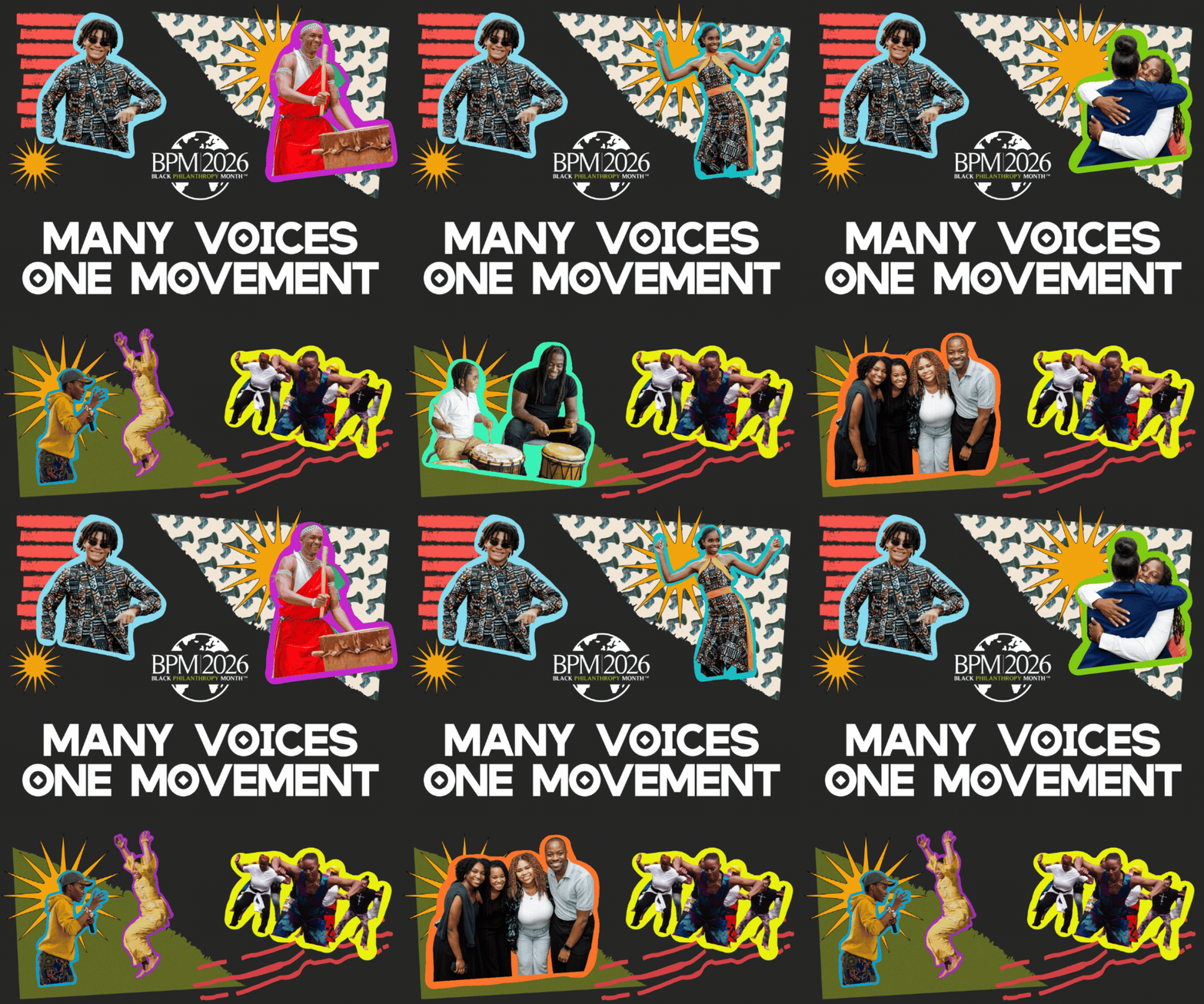
Both European colonists and enslaved Africans brought distinct traditions of giving to North America concurrently during the earliest days of the colonization of North America. However, the roots of these approaches to philanthropy differ, and Black Philanthropy Month is focused on highlighting the traditions and contributions of Black people, rather than assuming that the Eurocentric approaches to philanthropy are the only ways this work has been done.
Now that we have THAT out of the way, let’s talk a little about the history of Black philanthropy.
The History of Black Philanthropy
Black philanthropy began with enslaved Africans, and as a result was largely rooted in West African traditions. Over times, these cultural traditions were upheld and adapted through the survival of enslaved communities, and included:
Seeing giving as a core component of relationships rather than a transactional act - generosity was understood as a normal part of having relationships
A focus on mutuality and recognizing that the “haves” and “have nots” aren’t fixed roles, we all experience both
Understanding that stability and resilience are the result of collective efforts - survival relied upon practices like pooling resources, looking out for one another, and welcoming everyone as family, regardless of biology
Under the awful conditions of slavery, mutual support became a critical means of survival. Enslaved Africans shared food, emotional support, and medical care with one another, forming familial bonds to withstand the oppression and dehumanization they faced. Then, when Black people were released from slavery, they pooled their money to buy loved ones out of bondage and supports others escaping from slavery. They also went on to fund churches and schools, support abolitionist newspapers, and build community institutions.
From it’s earliest acts to now, Black philanthropy in America has consistently taken the form of pooled resources, mutual aid, church-based giving, informal family and community support, institution-building, and movement funding. Not from generosity, but from necessity, as Black people were acutely aware that the systems around them were either excluding them, exploiting them, or pretending not to see them - so it was up to them to support one another.
Early examples of Black philanthropy
One of the earliest Black philanthropists, James Forten, was a free Black sailmaker and abolitionist in Philadelphia who became wealthy with the support of Robert Bridges, who left his sailmaking business to Forten after retiring. Rather than letting his fortune sit in the bank or only using it to improve his own life, Forten used the profits from these endeavors in the fight to end slavery, fund abolitionist publications, advance Philadelphia’s Black community, and create equal opportunities for people of African descent by:
Providing loans with interest to people who wanted to buy businesses or homes
Purchasing stocks in railroads, banks, insurance companies, and the building of canals
Buying property and renting out rooms to both individuals and businesses
Fundrasing for and personally financing abolitionist newspapers
Assisting people escaping slavery
Developing training opportunities for Black youth to learn trades
While Forton’s philanthropy was pretty unique given the times, Black philanthropy was never only contributed by people with wealth and privilege.
For example, The Free African Society was founded in Philadelphia on April 12, 1787, by Absalom Jones and Richard Allen after their fellow Black worshippers faced segregation and mistreatment at Philadelphia's St. George's Methodist Episcopal Church. In response, the Free African Society collected monthly dues from members (one shilling!) and used that money to provide vital financial, social, and spiritual support to free Black people, widows, and orphans, laying the foundation for mutual aid societies in the United States.
Black institution-building carried communities through exclusion
Black philanthropy has never been characterized or understood as random generosity. Instead, it was composed of brave and dedicated individuals committed to building parallel systems for the Black community because public systems and white-led institutions failed or refused to serve Black communities.
One of the backbones of this work was the Black church. Black churches historically served as spiritual, social, educational, political, and financial hubs. After the emancipation of chattel slavery, Black churches helped launch schools, orphanages, mutual aid societies, colleges, and community services. Other fraternal organizations, including theGrand United Order of Odd Fellows in America, founded in 1843 after white lodges refused them entry, were formed and provided life insurance, health care, social welfare, and economic support when public systems excluded Black communities.
Even as American citizens began to advocate for greater equality for Black people, Black philanthropy still contributed the majority of fiscal and social resources needed to uplift the Black community. During the Civil Rights Movement, many White foundations avoided funding civil rights work because it was controversial, politically risky, or too closely tied to protest, legislation, and grassroots pressure. Some foundations were active in supporting educational opportunities and economic self-help for Black communities, but far fewer contributed funding for the organizing and structural-change work needed to confront racial injustice directly.
The state of Black philanthropy in 2026
I wish I could say that the history of Black philanthropy is in fact, history, but that would be a lie. The vast majority of Eurocentric philanthropy comes in the form of large checks, named buildings, formal foundations, and grant portfolios. But much of Black philanthropy continues to come from relationships, churches, family networks, mutual aid, and community institutions.
In 2020, following the murder of George Floyd and the subsequent national attention regarding police brutality in the Black community, there was an increase in larger scale investment and funding into Black-serving community organizations. By 2024, this momentum had plateaued in many places. A closer look at this pattern revealed that organizations generally received one-time grants during this time, rather than sustained, multi-year investments. A new pattern is emerging, one that most marginalized groups know well, particularly the Black community. Minority institutions SO receive attention in moments of crisis, but they rarely receive the funding needed to build the long-term infrastructure needed to sustain and expand their work.
The good (good-ish?) news is, Black philanthropy has never relied on external sources for stability or resilience. Black philanthropy has included major donors, yes, but it has also included the auntie sending money to a niece at an HBCU, the church collecting money for a family in crisis, the mutual aid group covering burial costs, the neighbor watching someone’s children, and the community members giving what they could because somebody’s survival depended on it.
I have full confidence that Black people will continue to be resilient in the face of adversity, find strength from within, and look out for one another. But Black Philanthropy Month isn’t really for Black people, is it? It’s to bring awareness to this struggle and offer an invitation to those who come from outside the community - to join us in lifting up the descendants of those whose backs this country was built upon.
Conclusion
The Black community has done their part, and truthfully, I might argue that they’ve outdone themselves. African Americans give at least $11 billion to charities each year, and contribute the highest percentage of their wealth to charitable and philanthropic causes among American racial and ethnic groups, despite the racial wealth gap.
Black Philanthropy Month can be a celebration, but it should also be a mirror.
The story here isn’t that Black communities are just now discovering generosity or leadership or the will to build. The story is that Black communities have been doing this work for the long-haul, in churches, schools, mutual aid, bail funds, scholarship pots, family networks, movement infrastructure — while the philanthropic sector acts like Black-led institutions are temporary causes that need to be “tested” before they can be trusted.
If you’re reading this and want to be part of writing a NEW story for Black Americans, don’t use this as motivation to offer your two cents. Provide your support by getting behind the people have been doing this work since they got here, and provide Black organizations with things like:
Unrestricted, flexible capital
Multi-year grants
General operating support
Infrastructure and administrative capacity
Leadership development
Technology and systems
Research capacity
Endowments
Scholarships and personnel
Cohort-based ecosystem investment
Trust-based giving that reduces burdensome reporting and centers recipient expertise
Black institutions have been doing the work with less, for longer, under harder conditions. The sector’s job now is not to discover Black brilliance. It’s to stop underfunding it.
